

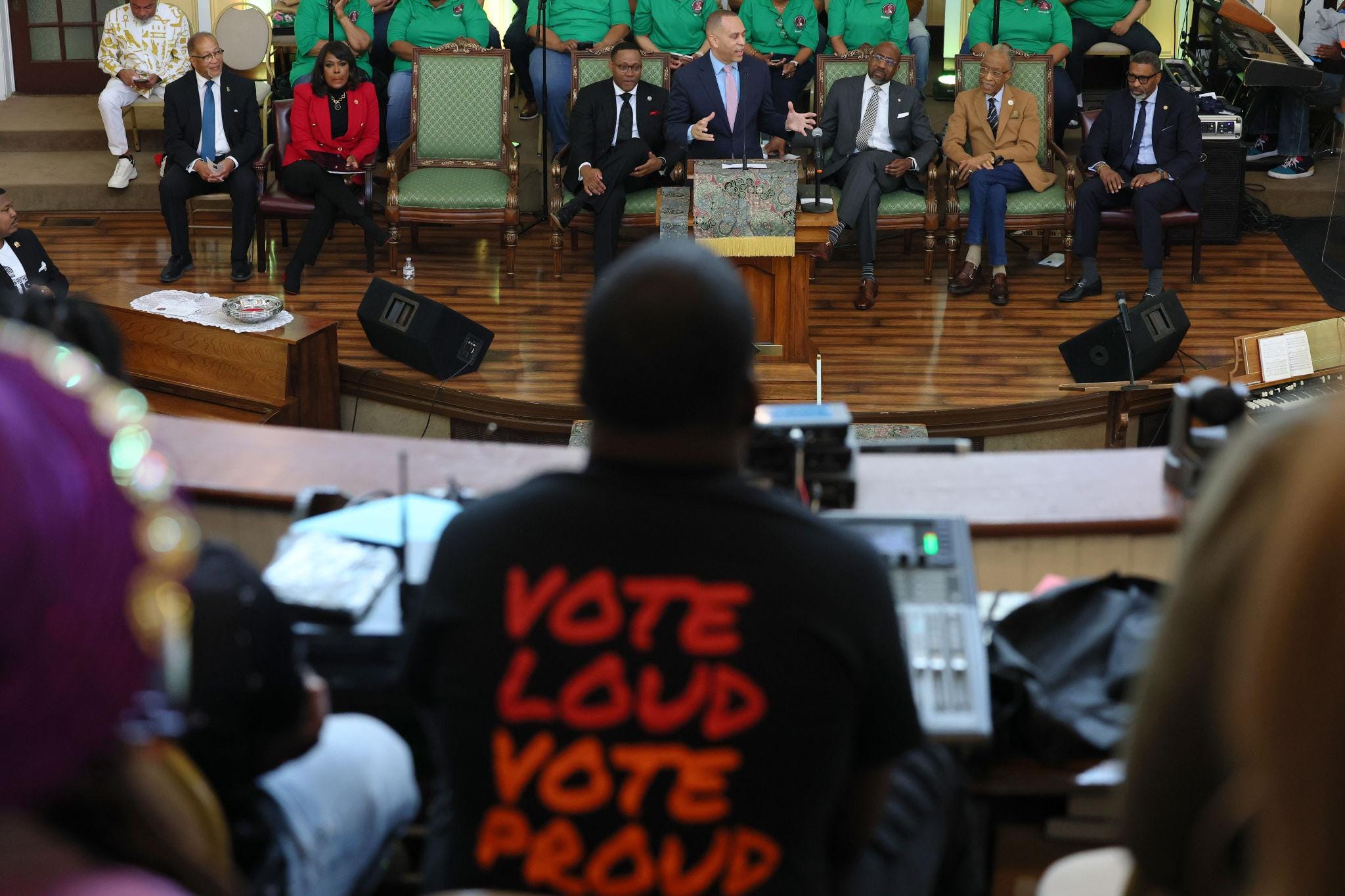
Two days ago, Michigan Representative Haley Stevens attended services at Perfecting Church, one of Detroit’s most prominent Black congregations, alongside Republican Senate nominee Mike Rogers and his wife.
Etymologists will tell you that a political “prop” is merely a theatrical metaphor. The word traces back to its Germanic and Old Norse roots. It refers to a support beam, a plug, or a stage object used to create the illusion of a reality. They will argue, with academic distance, that it is entirely distinct from “property,” which stems from the Latin proprietas—the legal right to ownership.
But in the theater of Amerikan politics, this is a distinction without a operational difference.
To understand why the sight of a politician deploying Black spaces feels so viscerally offensive, one must look to classical jurisprudence. Under Roman law, a foundational contradiction exists: a person cannot be a thing, and a thing cannot be a person. A persona possesses agency; a res is merely a utility. Yet, The US attempted a horrific legal alchemy by transforming human souls into chattel/cattle, reducing a living people into instruments of the European’s theft and greed.
The underlying political psychology—the habit of reducing Black humanity to a transactional utility—remains. It is a manifestation in the bipartisan ritual of the political prop. When a political campaign uses Black bodies, Black culture, or Black sacred spaces to support its own structural facade, it is operating on that same grim continuum. They may no longer claim to own the people, but they still seek to lease the culture.
Perfecting The Imperfect
The recent controversy surrounding Representative Haley Stevens is merely the latest entry in this long, bipartisan ledger of hypocrisy. When Stevens announced her defection from the Democratic Party to endorse a Republican from the pulpit of Detroit’s Perfecting Church, the immediate backlash was familiar: she was accused of using the Black church as a stage prop. This hypocritical excrement does not belong to one side of the aisle.
We The People? Or We The Property?
The Democratic Party, which historically treats the Black electorate as a captive constituency, has long mastered this performative proximity. We saw it in 2007, when Hillary Clinton stood in a Selma pulpit and suddenly adopted a Southern drawl to quote a gospel hymn—a paternalistic performance of authenticity that treated Black culture as a coat to be put on and discarded. We saw it in Joe Biden’s rhetorical maneuvers, from his dated, paternalistic anecdotes about “Cornpop” to his explicit declaration on the Breakfast Club that “you ain’t Black” if you dare to question his platform. We saw it when Michael Bloomberg, after spending years aggressively defending “stop-and-frisk” policing, suddenly discovered repentance at a Brooklyn mega-church just days before launching his presidential campaign. For Democrats, the Black church is a seasonal engine, visited in October and November to secure the lock on their political property.
The Republican Party uses the exact same stagecraft, but for a different tactical end. For the GOP, the Black pulpit is a shield. When Donald Trump visited Great Faith Ministries in Detroit in 2016, dancing awkwardly with a traditional prayer shawl draped over his shoulders, the event was never designed to genuinely convert Black voters. It was a visual asset designed to signal to moderate European-Amerikan suburbanites that the campaign was safe, inclusive, and decent. We see it in the architecture of modern political conventions, where Black speakers are prominently featured to deliver speeches decrying how Democrats take voters for granted, while the cameras carefully crop out a convention floor that is overwhelmingly European-Amerokan. For Republicans, the Black space is rented to project an illusion of diversity, using Black faces to validate a platform they had no hand in building.
This is the core hypocrisy that unites the duopoly: the trade-off between symbolic proximity and material return. Politicians from both sides use Black People in the US as a minstrel show. They will clap (and move oh so unsteadily) to the music, nod from the altar, and mimic the cadence of the preacher. But when the cameras turn off, that cultural proximity rarely translates into a corresponding commitment to closing the racial wealth gap, funding local infrastructure, or dismantling systemic judicial and health disparities. The space is used, the photo op is captured, and the utility is exhausted. Literally, and in more ways than one.
No more barbecue and “hot sauce in my purse.”
To reduce a living, breathing, complex constituency into a static background set piece is an act of sociopolitical dehumanization. It demands that the congregation remain silent extras in their own sanctuary, existing only to provide a veneer of moral authority to a politician’s personal ambition. Frankly, Black People in the US have no one to blame but themselves for allowing it and being useful idiots.
Whether the dictionary connects the words or not, the political behavior converges perfectly. When modern campaigns treat Black People in the US as props to hold up their platforms, they echo the foundational lie of Amerikan property law. They reduce the persona back to the res. And in doing so, they remind us that in the eyes of the Amerikan political establishment, Black communities are still too often viewed not as sovereign agents to be served, but as assets to be managed.
Democratic Party Examples
Historically, the Democratic Party relies heavily on Black voters as a core constituency, leading to frequent campaign stops at Black institutions that critics often argue feel performative.
Hillary Clinton’s “I Ain’t No Ways Tired” (2007): During a speech at the First Baptist Church in Selma, Alabama, Clinton adopted a distinct Southern drawl while quoting a traditional gospel hymn. Critics slammed the sudden shift in cadence and dialect as a forced, paternalistic attempt to perform authenticity for a Black audience.
Joe Biden’s “Cornpop” & “You Ain’t Black” (2020): Joe Biden’s rhetorical choices have frequently drawn scrutiny. His recurring anecdote about a 1960s gang leader named “Cornpop” at a Wilmington pool was widely memed and criticized for leaning into dated, paternalistic tropes of urban conflict. More directly, his 2020 comment on The Breakfast Club—telling host Charlamagne that “if you have a problem figuring out whether you’re for me or Trump, then you ain’t Black”—was heavily criticized for assuming ownership over Black political identity.
Michael Bloomberg’s Apology at Christian Cultural Center (2019): Just days before launching his 2020 presidential bid, billionaire Michael Bloomberg stood before a mega-church congregation in Brooklyn to issue a stark apology for his administration’s “stop-and-frisk” policing policy. Because he had aggressively defended the policy for years, critics and columnists widely condemned the timing as a calculated, transactional maneuver to court Black primary voters.
Republican Party Examples
The Republican Party frequently uses Black spaces to project an image of inclusivity, visual diversity, or to validate a sudden shift in policy or alignment.
Donald Trump’s Visit to Great Faith Ministries (2016): During his first presidential campaign, Donald Trump visited a Bishop-led church in Detroit. He danced awkwardly with a traditional Jewish tallit prayer shawl draped over his shoulders, which had been gifted to him by the pastor. Satirists and political analysts analyzed the event as an overt photo-op designed less to convert Black voters and more to signal to moderate European-Amerikan suburbanites that his campaign was inclusive.
The 2020 RNC “Hostages to One Party” Appeals: During the 2020 Republican National Convention, the party heavily featured Black speakers—such as Senator Tim Scott, Herschel Walker, and Vernon Jones—who delivered speeches arguing that Democrats take Black voters for granted. While the messaging targeted a real frustration, critics pointed out the stark visual contradiction: the RNC used Black faces on screen to appeal to a base and a convention delegation that was overwhelmingly European-Amerikan.
George W. Bush’s Faith-Based Initiatives (2001–2004): The Bush administration aggressively courted Black pastors by routing billions of dollars in federal funding directly to religious charities through the Office of Faith-Based and Community Initiatives. While it provided resources to some communities, political scientists noted that it successfully leveraged the social capital of the Black church to soften the GOP’s image on civil rights and secure key pastoral endorsements.
Though it may morph, the constant insult that Black People in the United States endure will never change. It cannot any more than a person…can be a thing. Same shit, different smell.
It's disgusting to watch in every election cycle,your essay rings so damn True. It sickens me. Please know how much I appreciate you keeping me in touch with reality and knowing the opposite is hard to stomach. Thank You, Rohn 🙏
So True my friend...🎯